Cookies help us enhance your experience on our site by storing
information about your preferences and interactions. You can customize your
cookie settings by choosing which cookies to allow. Please note that disabling
certain cookies might impact the functionality and features of our services,
such as personalized content and suggestions.
Cookie Policy
These cookies are strictly necessary for the site to work and may not be disabled.
Cookie name
Description
Lifetime
Provider
_ce.clock_data
Store the difference in time from the server's time and the current browser.
1 day
Crazy Egg
_ce.clock_event
Prevent repeated requests to the Clock API.
1 day
Crazy Egg
_ce.irv
Store isReturning value during the session
Session
Crazy Egg
_ce.s
Track a recording visitor session unique ID, tracking host and start time
1 year
Crazy Egg
_hjSessionUser_2909345
Store a unique user identifier to track user sessions and interactions for analytics purposes.
1 year
HotJar
_hjSession_2909345
Store session data to identify and analyze individual user sessions.
1 day
HotJar
apt.uid
Store a unique user identifier for tracking and personalization.
1 year
Mageplaza
cebs
Store user preferences and settings.
Session
Mageplaza
cf_clearance
Store a token that indicates a user has passed a Cloudflare security challenge.
1 year
Cloudflare
crisp-client
The crisp-client/session cookie is used to identify and maintain a user session within the Crisp platform. It allows the live chat system to recognize returning users, maintain chat history, and ensure continuity in customer service interactions.
Session
Crisp
_ga
Store a unique client identifier (Client ID) for tracking user interactions on the
2 years
Google
_ga_7B0PZZW26Z
Store session state information for Google Analytics 4.
2 years
Google
_ga_JTRV42NV3L
Store session state information for Google Analytics 4.
2 years
Google
_ga_R3HWQ50MM4
Store a unique client identifier (Client ID) for tracking user interactions on the website.
2 years
Google
_gid
Store a unique client identifier (Client ID) for tracking user interactions on the website.
1 day
Google
_gat_UA-76130628-1
Throttle the request rate to Google Analytics servers.
1 day
Google
Advertising cookies
Advertising cookies deliver ads relevant to your interests, limit ad frequency, and measure ad effectiveness.
Advertising cookies deliver ads relevant to your interests, limit ad frequency, and measure ad effectiveness.
Cookie name
Description
Lifetime
Provider
_gcl_au
The cookie is used by Google to track and store conversions.
1 day
Google
__Secure-3PAPISID
This cookie is used for targeting purposes to build a profile of the website visitor's interests in order to show relevant and personalized Google advertising.
2 years
Google
HSID
This security cookie is used by Google to confirm visitor authenticity, prevent fraudulent use of login data and protect visitor data from unauthorized access.
2 years
Google
__Secure-1PSID
This cookie is used for targeting purposes to build a profile of the website visitor's interests in order to show relevant and personalized Google advertising.
2 years
Google
SID
This security cookie is used by Google to confirm visitor authenticity, prevent fraudulent use of login data and protect visitor data from unauthorized access.
2 years
Google
APISID
This cookie is used by Google to display personalized advertisements on Google sites, based on recent searches and previous interactions.
2 years
Google
__Secure-1PAPISID
This cookie is used for targeting purposes to build a profile of the website visitor's interests in order to show relevant and personalized Google advertising.
2 years
Google
__Secure-3PSID
This cookie is used for targeting purposes to build a profile of the website visitor's interests in order to show relevant and personalized Google advertising.
2 years
Google
SSID
This cookie is used by Google to display personalized advertisements on Google sites, based on recent searches and previous interactions.
2 years
Google
SAPISID
This cookie is used by Google to display personalized advertisements on Google sites, based on recent searches and previous interactions.
2 years
Google
__Secure-3PSIDTS
This cookie collects information about visitor's interactions with Google services and ads. It is used to measure advertising effectiveness and deliver personalised content based on interests. The cookie contains a unique identifier.
2 years
Google
__Secure-1PSIDTS
This cookie collects information about visitor's interactions with Google services and ads. It is used to measure advertising effectiveness and deliver personalised content based on interests. The cookie contains a unique identifier.
2 years
Google
SIDCC
This security cookie is used by Google to confirm visitor authenticity, prevent fraudulent use of login data, and protect visitor data from unauthorized access.
3 months
Google
__Secure-1PSIDCC
This cookie is used for targeting purposes to build a profile of the website visitor's interests in order to show relevant and personalized Google advertising.
1 year
Google
__Secure-3PSIDCC
This cookie is used for targeting purposes to build a profile of the website visitor's interests in order to show relevant and personalized Google advertising.
1 year
Google
1P_JAR
This cookie is a Google Analytics Cookie created by Google DoubleClick and used to show personalized advertisements (ads) based on previous visits to the website.
1 month
Google
NID
Show Google ads in Google services for signed-out users.
6 months
Google
Analytics cookies
Analytics cookies collect information and report website usage statistics without personally identifying individual visitors to Google.
Analytics cookies collect information and report website usage statistics without personally identifying individual visitors to Google.
Cookie name
Description
Lifetime
Provider
_dc_gtm
Manage and deploy marketing tags through Google Tag Manager.
1 year
Google
1P_JAR
Gather website statistics and track conversion rates for Google AdWords campaigns.
1 month
Google
AEC
1 month
Google
ar_debug
Debugging purposes related to augmented reality (AR) functionalities.
1 month
Doubleclick
IDE
The IDE cookie is used by Google DoubleClick to register and report the user's actions after viewing or clicking on one of the advertiser's ads with the purpose of measuring the effectiveness of an ad and to present targeted ads to the user.
1 year
Doubleclick
ad_storage
Enables storage, such as cookies (web) or device identifiers (apps), related to advertising.
1 year
Google
ad_user_data
Sets consent for sending user data to Google for online advertising purposes.
1 year
Google
ad_personalization
Sets consent for personalized advertising.
1 year
Google
analytics_storage
Enables storage, such as cookies (web) or device identifiers (apps), related to analytics, for example, visit duration.
What is AJAX? Advantages & Disadvantages of Ajax? - Mageplaza
What is AJAX? Advantages and Disadvantages Explained (2025 Guide)
Vinh Jacker|03-17-2025
For web developers, the “Ajax” term is quite a common tech jargon over the past few years due to its increasing application in practice.
Though the use of Ajax technology for web applications is simple, it shows excellent development potential. For a deeper understanding, let’s discuss the advantages and disadvantages of Ajax. Plus, find out some practices of Ajax technology in Magento 2.
Without further ado, let’s dive in!
What is Ajax?
What is Ajax?
It won’t take much time for us to have a quick look at the definition of Ajax. At the most basic level, the acronym of Ajax is Asynchronous JavaScrip and XML.
You can understand it as a set of web development techniques that are used to create better and faster web applications via the use of XML, HTML, CSS, Javascript.
In other words, web applications apply Ajax technology to send and retrieve data from a server without interrupting the display of the existing page.
One of the most outstanding features of AJAX is the ability to retrieve data from the server without the need to refresh the page. Thanks to it, the request traffic on your servers will be reduced significantly, speeding up loading time and improving user experience. And you know what the best part is? It’s the user experience is not interrupted at all.
AJAX lets web pages update content without reloading the whole page, creating a faster and smoother experience, much like using a desktop app.
Fasten Response Times
By sending only the necessary data to the server, AJAX minimizes bandwidth usage, making it easier and quicker to fetch required information and enhancing website loading speeds.
Reduce Server Load
AJAX fetches and updates only the needed data asynchronously, reducing the amount of data exchanged between client and server. This results in lower server load and more efficient resource utilization, even for applications handling large datasets or frequent updates.
Enable Asynchronous Calls
AJAX also allows asynchronous data fetching, ensuring that users can interact with the application seamlessly while information is being processed in the background.
Improve User Experience
With AJAX, you can update specific sections of a web page dynamically without reloading the entire page. This enables quick, uninterrupted interactions, such as submitting forms or loading new data, delivering a desktop-like, responsive experience that feels intuitive and gratifying.
Disadvantages of Ajax
Depend on JavaScript
AJAX relies heavily on JavaScript for server communication. If a user disables JavaScript in their browser, they won’t experience AJAX features like faster load times or dynamic updates.
More Complicated
Developing with AJAX can be challenging, especially for developers unfamiliar with asynchronous programming, increasing the complexity of web projects.
SEO Limitations
Dynamically loaded AJAX content can be difficult for search engines to index, potentially impacting the site’s search engine rankings.
Security Risks
Without proper safeguards, AJAX applications are vulnerable to security threats such as cross-site scripting (XSS) and cross-site request forgery (CSRF).
Back Button And Bookmarking Problems
AJAX-driven content changes often don’t update the URL, which can cause issues with browser back buttons and bookmarking, leading to a less intuitive user experience.
The application of Ajax for Magento 2
Ajax can be utilized in many cases where small amounts of data should be stored or received from the server without having to reload the whole page. Thus, web owners can deliver a far more seamless experience when browsing the entire store.
Still, developing a feature for web applications from scratch can cost time and effort. But don’t worry since there are many well-built extensions using Ajax technology out there.
All you need to do is download and install the modules that fit your needs to use. So below are some extensions with the usage of Ajax technologies for your Magento 2 stores.
Magento 2 Lazy Loading
As mentioned earlier, lazy loading is a term given to Ajax coding used to speed up the rendering process on a website. A Magento 2 Lazy Loading extension, as its name suggests, improves the web load speed by displaying web images only at the demanding time.
The Lazy Loading module applies the Ajax technology for loading images. In particular, the module helps you:
Reduce the time loading unnecessary images: Only images within the customer’s viewable part of the page will be loaded.
Prioritize important pages: Allow merchants to choose which page to apply Lazy Loading.
Offer diverse loading effects: Make your shopping experience more fun by providing various effects, including transparent, blur, and low resolution.
Set loading point time: Admins can use the threshold parameter to set up image loading time, making it load earlier than Magento default.
These feature benefits eCommerce websites significantly in giving customers a frictionless browsing experience.
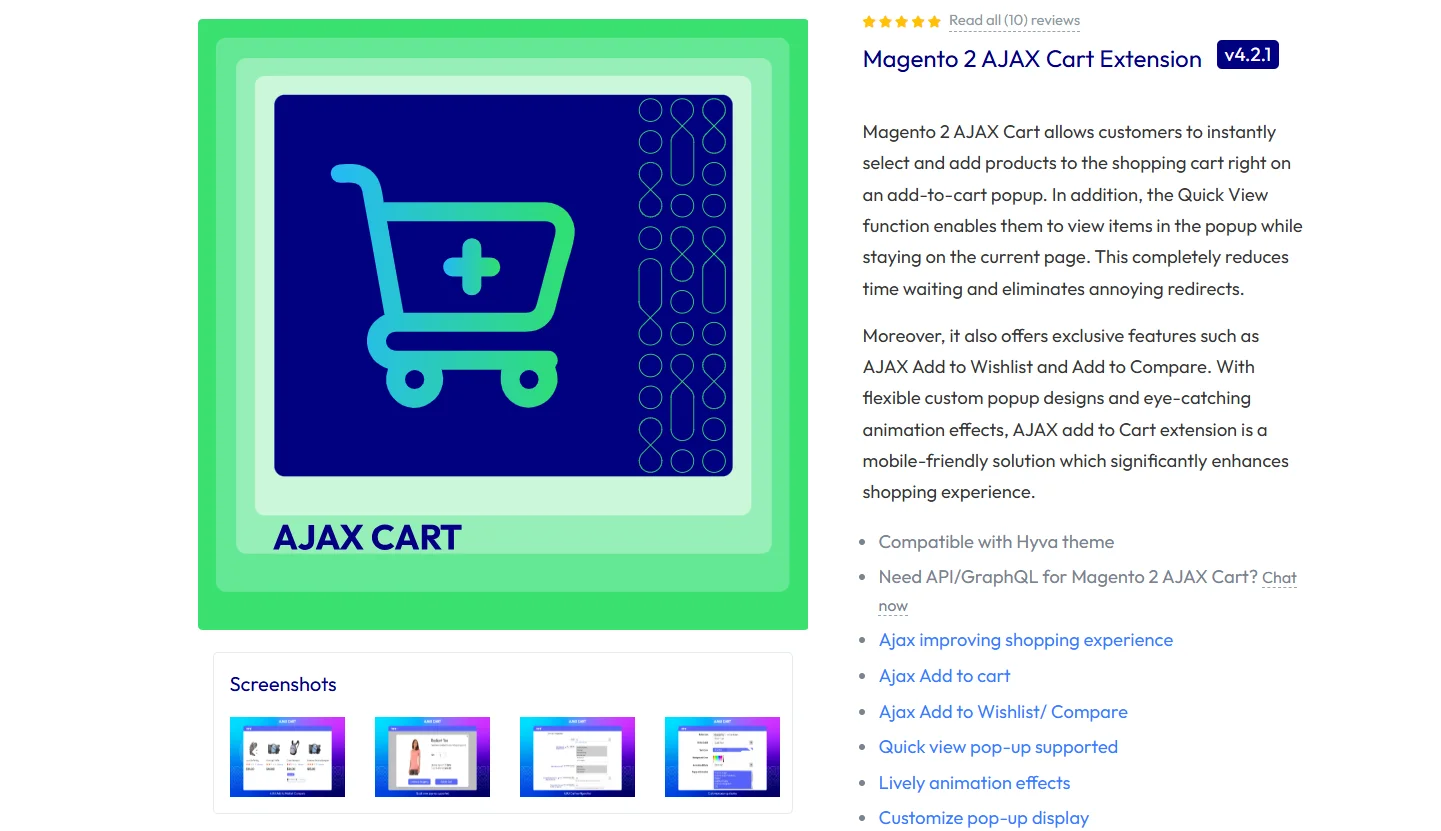
If the Magento 2 Lazy Loading focuses on optimizing the image load speed, Ajax Cart & Quick View for Magento 2 delivers a better shopping experience when customers come to the shopping cart.
Specifically, your customers can instantly select and add products to their cart via an add-to-cart popup. Of course, this popup is built using Ajax technology. It’s included in:
Add to Cart
Add to Compare
Add to Wishlist
With this module, you can enhance customers’ shopping experience on a user-friendly shopping site effortlessly.
Magento 2 Ajax Search
Ajax Search for Magento 2
Search Extension Magento 2 allows consumers to get auto-complete search results as soon as they enter a word in the search field.
The search results will be shown in a drop-down list right under the search field and include all essential info of each suggested items, particularly:
Image
Product name
Price
A short description
Rating and review
SKU
This feature is hugely beneficial for web visitors since they can quickly and conveniently find their wanted products.
It’s undeniable that Ajax technology gives online businesses a new approach and method to communicate with a web page in a way that effectively improves user experience.
We hope that this guide will assist you in learning and utilizing it effectively. Thank you for taking the time to read this!
Jacker is the Chief Technology Officer (CTO) at Mageplaza, bringing over 10 years of experience in Magento, Shopify, and other eCommerce platforms. With deep technical expertise, he has led numerous successful projects, optimizing and scaling online stores for global brands. Beyond his work in eCommerce development, he is passionate about running and swimming.
Learn how to analyze website traffic in Google Analytics 4, identify high-quality traffic sources, and grow your Magento 2 store with data-driven insights.
Master UTM parameters and Google Analytics for Magento. Track traffic sources, measure campaign performance, and practical tips to use it for better business decisions.
Learn how to analyze website traffic in Google Analytics 4, identify high-quality traffic sources, and grow your Magento 2 store with data-driven insights.
Master UTM parameters and Google Analytics for Magento. Track traffic sources, measure campaign performance, and practical tips to use it for better business decisions.